

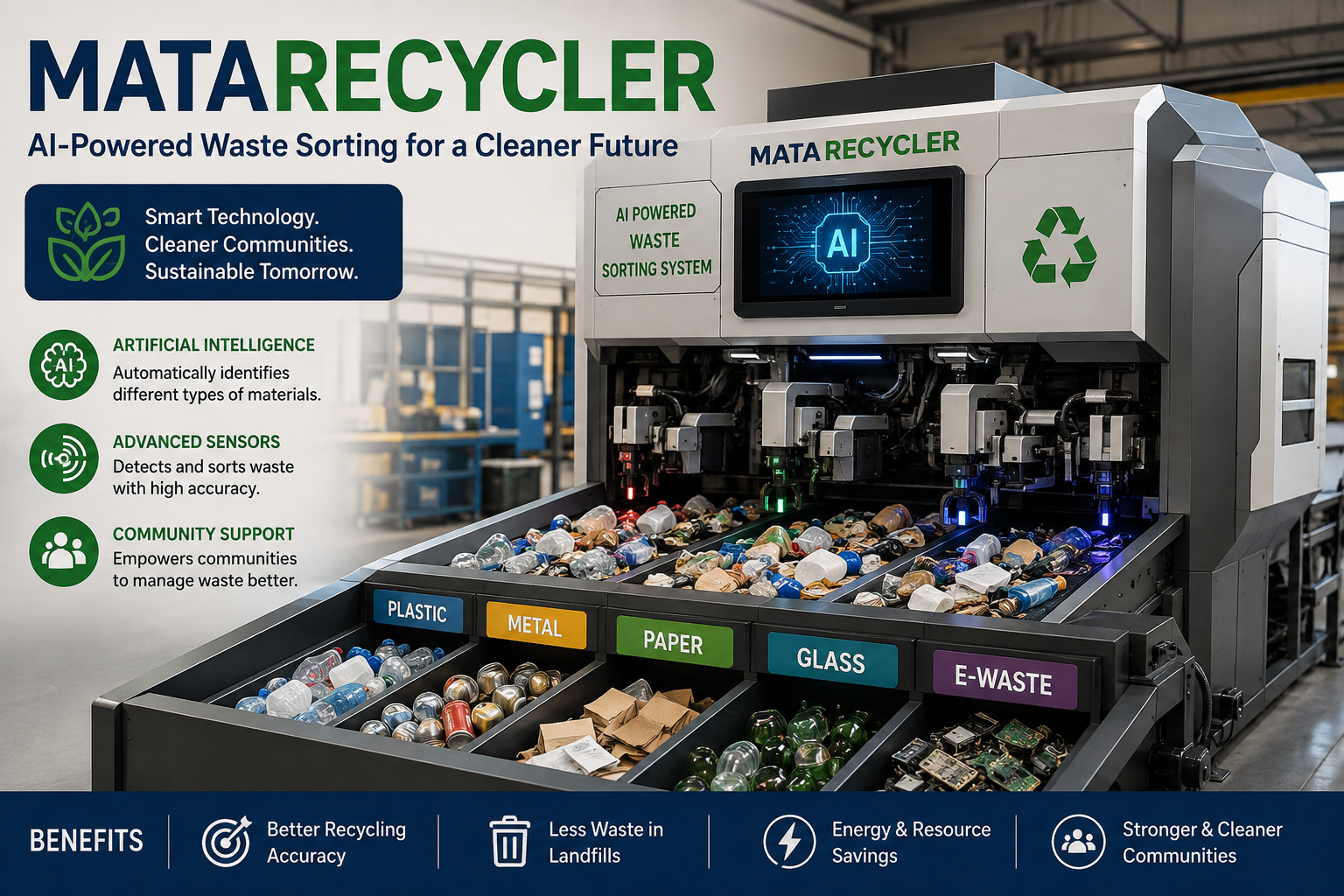
Waste management has become one of the most important environmental challenges facing modern communities. Although many people try to recycle responsibly, the process often becomes ineffective when materials are mixed, contaminated, or placed in the wrong container. MataRecycler represents a smarter approach by combining artificial intelligence, advanced sensors, automated identification, and community-focused recycling support. Instead of treating waste as one mixed stream, the technology is designed to recognize materials, separate useful items, and help recyclable resources return to productive use. Its central idea is that intelligent technology can make recycling more accurate, efficient, and accessible.
What Is MataRecycler?
MataRecycler is best understood as an emerging AI-powered waste-sorting concept designed to improve the way communities identify, separate, and manage recyclable materials. Traditional recycling systems often depend on residents choosing the correct bin and workers sorting large volumes of mixed waste later. MataRecycler introduces a more technology-led process in which cameras, smart sensors, and machine-learning systems examine discarded items and determine what type of material they contain. The system may recognize categories such as plastic, glass, metal, paper, cardboard, and certain electronic components. Once an item has been identified, an automated mechanism can direct it towards the appropriate recycling stream. This combination could reduce contamination and recover resources that might otherwise reach landfill.
Why Traditional Recycling Needs Improvement
Recycling appears straightforward, but the real process is complicated. A container may look recyclable while containing several materials that must be separated. Food residue can make paper or cardboard unsuitable for processing, while different plastic products may require different treatment. Labels, lids, coatings, adhesives, and mixed packaging can make correct identification difficult for ordinary residents. When too many unsuitable objects enter a recycling stream, they lower the quality of recovered material and may cause an entire load to be rejected. MataRecycler addresses this weakness by introducing a more consistent identification process. AI systems do not rely only on a person’s memory or a printed recycling symbol. They can be trained to examine visual features, shapes, textures, colors, and other material signals, supporting better decisions at the disposal point or inside a material recovery facility.
How Artificial Intelligence Supports Waste Sorting
The intelligence behind Matarecycler depends on machine-learning models trained with large collections of waste images and material examples. During training, the system is shown different objects and taught to recognize patterns connected with plastic bottles, aluminum cans, cardboard packages, glass containers, circuit boards, and other waste categories. When a new item enters the sorting area, cameras capture its appearance, and the AI compares its features with patterns it has already learned. The result is a rapid classification that guides the next action. As the system receives more reliable data, it can become better at recognizing unusual packaging, damaged items, and newly introduced materials. Unlike a fixed mechanical sorter built for one narrow task, an intelligent system can be updated as packaging designs, local recycling rules, and waste streams change.
The Role of Smart Sensors
Visual recognition is valuable, but appearance alone may not always reveal what an object is made from. Two products can look similar while containing different materials, and a crushed or dirty item may be difficult for a camera to classify. Advanced sensors can strengthen the process by collecting additional information. Depending on the design, they may examine weight, density, surface properties, light response, metal content, or other physical characteristics. This extra data can help a matarecycler distinguish between items that appear almost identical. Sensors can also monitor how full a collection bin has become, detect unusual waste, and provide operational information to collection teams. When these features work together, the technology becomes more than a sorting machine; it becomes part of a broader smart waste management system.
Improving Recycling Accuracy
One of the main potential benefits of Matarecycler is more accurate material separation. Recycling facilities depend on clean streams because recovered materials are more useful and valuable when they contain fewer unwanted substances. Aluminum cans mixed with food waste, glass fragments, and plastic film are harder and more expensive to process than a clean metal stream. Intelligent identification can reduce these mistakes by checking items more consistently. Human involvement would remain important. Workers may supervise the equipment, handle hazardous objects, maintain machinery, and make decisions in uncertain cases. However, AI can manage repetitive classification tasks and allow staff to focus on safety and quality control. The combined result may be a more reliable operation with fewer recyclable materials lost during sorting.
Reducing Waste Sent to Landfills
Landfills still play a role in waste management, but they should not receive materials that can be reused or recycled. When plastic, metal, paper, and glass are buried, the energy and raw materials used to produce them are lost. MataRecycler aims to reduce this waste by recovering a greater share of useful material before final disposal. Even a modest improvement in sorting can become meaningful when applied across thousands of homes, businesses, or community collection points. Better separation can also help identify items that require special treatment, including batteries and electronic components. Keeping these objects away from general waste streams may reduce environmental risks while improving the recovery of valuable parts and metals. Through smarter sorting, matarecycler supports the wider goal of treating waste as a resource rather than as something with no remaining value.
Energy and Resource Savings
Producing goods from recycled material can reduce dependence on newly extracted resources. Recovered aluminum, paper fibers, glass, and certain plastics can be processed and returned to supply chains, reducing pressure on mining, forestry, and petroleum-based manufacturing. MataRecycler could support this process by improving the quality and availability of recyclable feedstock. When materials are identified and separated correctly, recycling plants receive cleaner inputs that are easier to process. This may reduce unnecessary transport, limit resource loss, and lower the energy required for some production activities. The technology itself still requires electricity, computing equipment, maintenance, and replacement parts, so it should not be described as impact-free. Its environmental value depends on efficient design and whether the recovered materials genuinely replace virgin production. Even so, responsible intelligent sorting can support meaningful energy conservation and resource efficiency.
Supporting Community Waste Management
MataRecycler is especially relevant at the community level because local recycling programs often struggle with inconsistent participation and limited information. Residents may want to recycle but feel confused by changing rules, while collection teams may follow fixed routes even when some bins are nearly empty, and others are overflowing. Municipal managers may also lack timely data about the materials being discarded or the locations where contamination happens most often. A connected recycling system can help close these gaps. Smart bins may provide instructions, recognize deposited items, record filling levels, and send useful information to waste managers. Communities could then plan collections more efficiently, improve public guidance, and identify neighborhoods that need additional support. Technology cannot create good habits alone, but it can make correct recycling easier.
Community Education and Public Participation
The success of matarecycler depends not only on machines but also on people. A technically advanced system will have limited impact if residents do not trust it, understand it, or have convenient access to it. Community education should therefore be treated as a central part of the model. Schools, businesses, housing associations, and local authorities can explain why material separation matters and how intelligent sorting improves recovery. Simple reports or public dashboards could show how much waste has been diverted from landfill, which materials are most frequently recovered, and where contamination remains high. Visible results can make recycling feel more meaningful because residents can see the connection between daily choices and environmental outcomes. When people receive understandable feedback, they are more likely to remain engaged and improve their recycling behavior.
Challenges and Limitations
Despite its potential, matarecycler should not be presented as a perfect solution. AI systems can make mistakes, particularly when objects are dirty, damaged, hidden, or made from several bonded materials. Sensors and automated equipment may be expensive to install, and smaller communities can struggle with funding, maintenance, technical skills, or reliable electricity. Machine-learning models also need high-quality training data that reflects local products and waste conditions. A system trained in one country may perform less effectively in another where packaging, labels, and disposal habits are different. Privacy and data governance may require attention if smart bins collect location or user information. These challenges do not remove the value of the concept, but they show why careful testing, transparent evaluation, and human supervision are necessary.
MataRecycler and the Circular Economy
The wider importance of MataRecycler becomes clearer through the idea of a circular economy. In a traditional linear system, raw materials are extracted, turned into products, used briefly, and discarded. A circular approach tries to keep products and materials useful for longer through repair, reuse, remanufacturing, and recycling. Intelligent sorting supports this model by helping valuable materials return to production instead of disappearing into landfill. Recycling, however, is only one part of circularity. Communities must also reduce unnecessary consumption, encourage reusable packaging, improve product design, and create stable markets for recovered materials. MataRecycler can support these efforts by producing better information about what is discarded and which materials are most difficult to recover.
The Future of Smart Recycling
The future of MataRecycler will depend on how effectively AI, robotics, sensors, local infrastructure, and public participation are combined. As computer vision improves, systems may recognize more material types and detect contamination earlier. Robotic sorting equipment may become safer, faster, and more affordable. Smart collection data could help municipalities reduce unnecessary vehicle journeys and respond more quickly to overflowing bins. Predictive maintenance may alert operators before equipment fails, while software updates could allow systems to adapt to new packaging. The strongest future model will not replace communities with machines. Instead, it will use technology to support informed decisions, protect workers, recover more resources, and make responsible disposal easier for ordinary people.
Conclusion
MataRecycler represents a forward-looking response to one of society’s most persistent environmental problems. By combining artificial intelligence, advanced sensors, automated material identification, and community waste-management support, it offers a possible path towards cleaner recycling streams and more efficient recovery of useful resources. Its potential benefits include improved sorting accuracy, lower landfill volumes, stronger waste data, energy savings, and better public participation. At the same time, successful implementation requires realistic planning, skilled maintenance, local training data, transparent performance measurement, and continued human oversight. MataRecycler should therefore be seen not as a magical replacement for responsible consumption but as a valuable tool within a wider sustainability strategy. When intelligent technology is paired with community education, accessible infrastructure, and circular-economy thinking, waste can be managed more responsibly, and more materials can remain useful for longer.